


At its 20th VIP Summit, the Los Cabos Tourism Board acknowledged U.S. arrivals are down 6% this year even as hotel rates keep climbing, and it launched its first global campaign.
Los Cabos had a rough 2026, and Rodrigo Esponda isn’t pretending otherwise.
U.S. arrivals are down 6%, the managing director of the Los Cabos Tourism Board told the advisors, partners, and press gathered this week for the destination’s 20th VIP Summit. A year ago, he said, the job was simply keeping Los Cabos top of mind.
“The market was growing; everything was fine,” Esponda said. “Now it’s not happening.”
So he is leaning harder on the partners he has cultivated over a decade in which annual visits grew 77%, from 2.12 million in 2016 to nearly 3.8 million in 2025, and nonstop service expanded from 21 U.S. cities to 55 cities worldwide.
This year tested everyone. Airfares spiked, storms scrambled travel plans, and headlines about cartel unrest elsewhere in Mexico cast a shadow over destinations far from the trouble, Los Cabos included. Canada is up, but the U.S. still carries the destination, accounting for about 80% of international visitors, Esponda said.
You wouldn’t have guessed it from the room. About 300 people attended the summit, held Oct. 25-27, including some 160 hosted travel advisors, tour operators, and partners from 21 markets, up from three when Esponda took over in 2016. Between the panels, meetings, and evening parties, the mood was upbeat.

The Luxury Lift
If 2026 had a bright spot, it was the top of the market.
“The high-end customer has been the most resilient,” Ray Snisky, group president of ALG Vacations, told reporters. “They have really had very little hiccup at all.”
More than 60% of ALG’s Mexico sales now go to five-star hotels, and its luxury division, Lux by ALGV, does nearly $500 million in revenue.
Los Cabos is well positioned for that traveler. Of its 22,545 hotel rooms, 80% are five-star, and the destination counts seven Forbes Travel Guide Five-Star hotels, nine AAA Five Diamond properties, and 16 Virtuoso hotels, the highest concentration of Virtuoso properties in Mexico, the Caribbean, and Latin America. In August, the board was named Best Tourism Board at Virtuoso Travel Week.
Even as U.S. arrivals dipped, the average daily rate climbed to $455 from January through July, up from $440 in 2025 and $286 in 2017, with occupancy at 72%. Private-aviation traffic has nearly quadrupled since 2016.
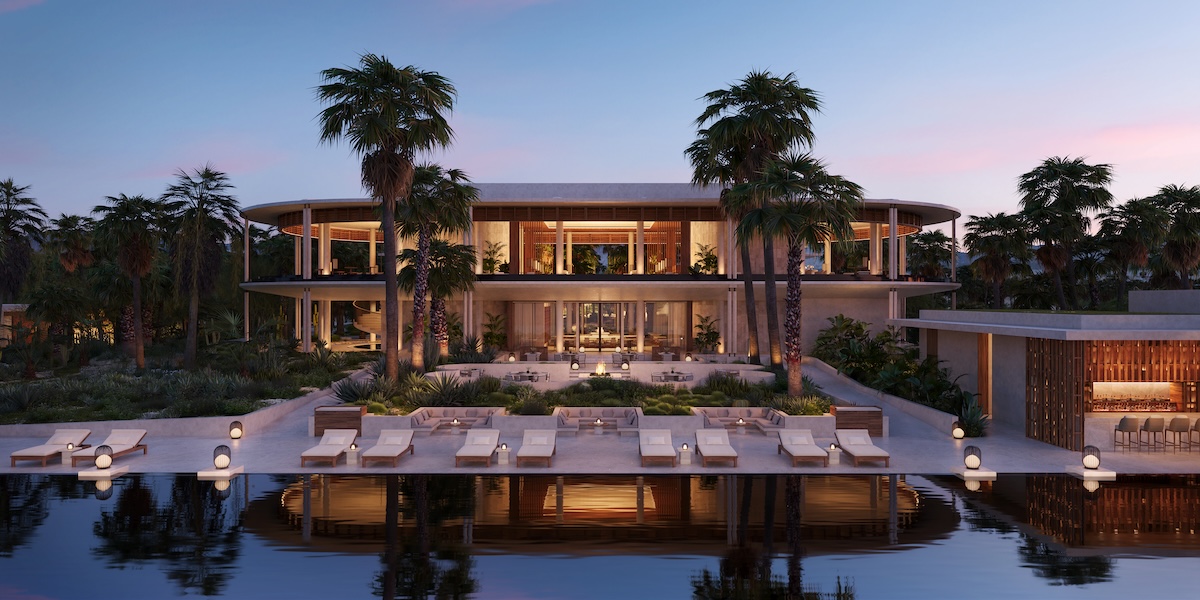
Investors have noticed. Park Hyatt Cabo Del Sol, the brand’s first hotel in Mexico, opened last December with 163 guest rooms and 88 suites, a low-slung composition of wood and stone set among cactus gardens above the Sea of Cortez. Cabo Del Sol itself is an increasingly posh private community, home to a Four Seasons, a soon-to-open Soho House, and the new Ánima Village, where Carolina Herrera, Tiffany & Co., and Cartier have set up shop. Amanvari, Aman’s first Mexico resort, opened on the East Cape this summer with 18 casitas.

More than 1,200 hotel rooms are in the pipeline through 2029. Oleada, a new development anchored by the first Ernie Els-designed golf course in Mexico, gets a 300-room Grand Hyatt by year’s end and a 175-room Conrad next year. Also due in 2027 are a 124-room St. Regis at Quivira and Kerzner’s wellness-focused Siro Palmilla, with a Raffles following in 2029.
The villa market is scaling right alongside the hotels. Cabo Villas, part of Nocturne Luxury Villas, manages 190 private homes in the region, the grandest with 10 bedrooms and renting for as much as $40,000 a night. That still looks like a bargain next to the Caribbean, said President Julie Byrd, whose sister companies include villa specialists in St. Barts.
“You could get a three-bedroom in St. Barts for $10,000 a night,” Byrd said. “Here you could get a 10-bedroom, fully staffed, ready to go.”
Cabo Villas’ advisor business is up almost 200% this year — the company pays a 12% commission — and December bookings have already hit budget.
“It Was Unprecedented”
The wider market had a harder year.
“I’ve been doing this a really long time. It was unprecedented,” Snisky said on the summit’s “Built Together” panel, ticking off last year’s Hurricane Melissa, February’s cartel unrest in Puerto Vallarta, blizzards that closed U.S. airports for days, five-hour TSA waits, and airfares up 20% to 40%. Then came the news coverage.
“When [media reports] would say cartel violence in Mexico, [travelers] blended the entire country,” he said, likening it to “not going to Miami because there was a gang fight in New York.”
Relief is on the schedule, at least. Snisky said the major U.S. carriers’ published schedules restore capacity to Mexico to 2024 levels in the second quarter.
In the meantime, the panel’s advice was to hold rate.
“I’d rather see overall transactions drop by 10% and maintain rate,” said Melissa Krueger, former CEO of Classic Vacations.
“The customer’s response to your rates sets the rate,” Snisky added, and when a rate isn’t landing, the answer is to “better communicate the value.”
Advisors do that better than anyone. They sell higher room categories and longer stays than consumers booking on their own, Snisky said, and 35% of Los Cabos visitors book through an advisor, according to the board’s exit survey. Asked whether AI threatens those bookings, Esponda didn’t hesitate.
“The opposite,” he said. “The advisors are the right ones to connect.”
The Road to 2036
The board’s 2036 vision is for Los Cabos to become the leading luxury destination in the Americas.
“Value over volume means being intentional about the markets we develop, the travelers we attract, the experiences we promote, and the partnerships we build,” Esponda said.
Alongside high-value tourism and market diversification, the plan prioritizes local economic opportunity and environmental conservation.
In the U.S., Canada, and Mexico, the goal is to keep repeat visitors (nearly 40% of the total) coming back with “a clearer value story,” protect airlift “route by route, case by case with the airlines,” and stay close to partners.
After that come markets with growth potential through air connectivity, such as Germany and Colombia, with Condor’s Frankfurt service and Copa’s Panama City hub as gateways, plus niche markets including the UK, Australia, and Japan. From January through July, passengers from Latin America rose 84% and from Australia 119%.
One Campaign, Many Perspectives
That global push is what Los Cabos X, the destination’s first single worldwide campaign, is meant to support. Until now, Los Cabos ran separate regional campaigns that “were all not aligned,” Esponda said.
“We are not launching the campaign because we’re down,” he said. “We are launching the campaign because we are expanding globally.”
Created by Miami-based Ernesto Adduci, the campaign trades postcard shots of the Arch for personal views of the destination from artists, residents, and travelers, starting with six-time Grammy winner St. Vincent, who visits and shoots in November, and adventure photographer Chris Burkard.
Twenty summits in, and a decade into Esponda’s tenure, Los Cabos has more to sell than ever and a tougher room to sell it to. Krueger put the goal plainly: “I would just love to get to a point at the 25th anniversary where we’re not having to prove to society the safety of Los Cabos or anywhere else in Mexico.”
Related Stories
Thompson Hotels Arrives in Rome
Four Greek Villas Join Mandarin Oriental Exceptional Homes
How Luxury Hotels Became the Ticket to Sold-Out Concerts
Norwegian’s New Great Stirrup Cay: What Advisors Should Know